
Burnout or Depression? How to Tell the Difference
By Kitty Ferguson-Mappus, MSSW, LCSW-S · 12 min read
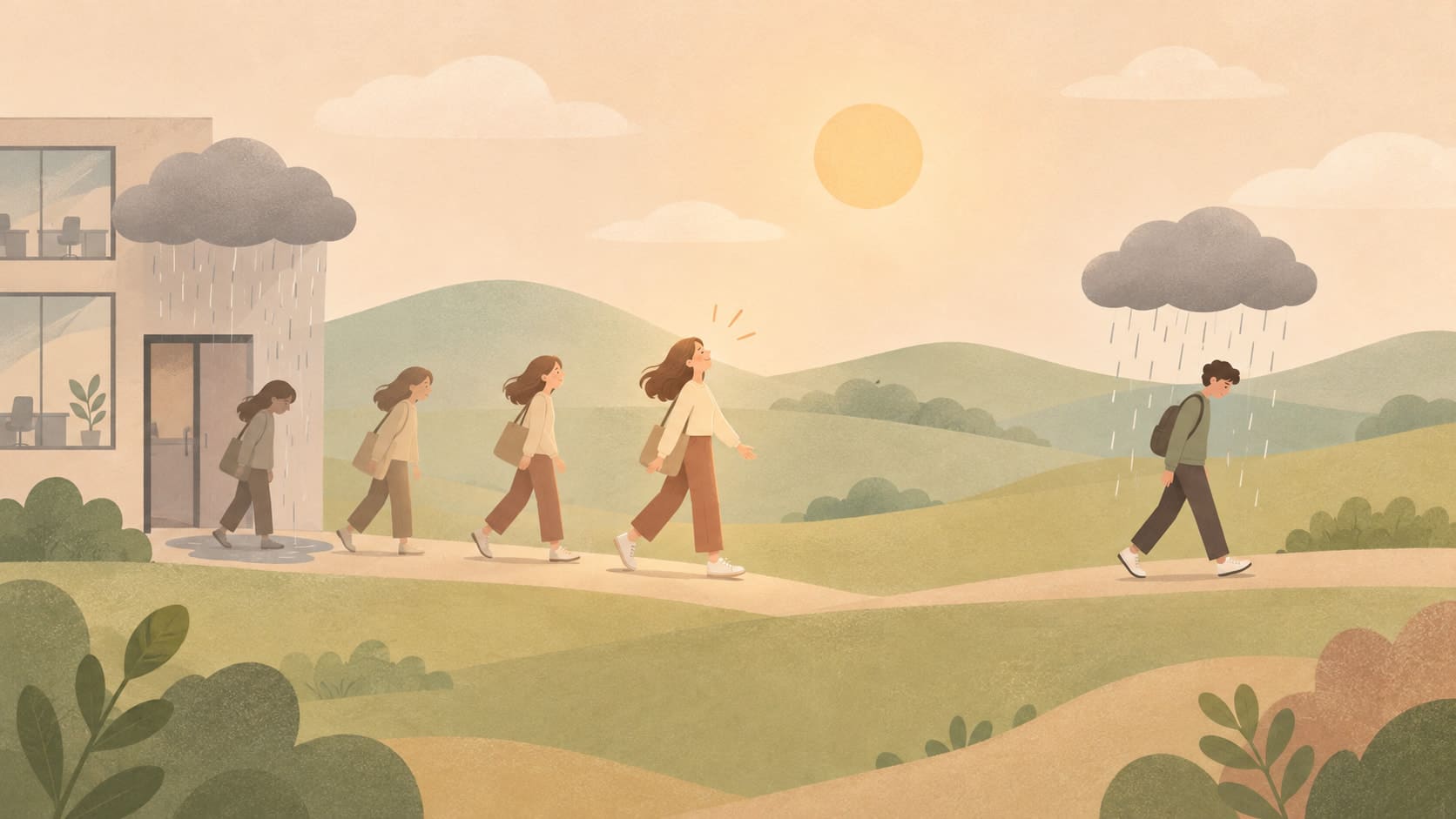
The core difference in burnout vs depression is that burnout is tied to a role and depression travels with you. The World Health Organization classifies burn-out as an occupational phenomenon, not a medical condition. Depression is a diagnosable mental health condition. Burnout usually eases away from the job; depression follows you into everything including what you love.
What to Know First
- Burnout and depression overlap so much that distinguishing between the two is often difficult.
- The WHO puts burn-out in ICD-11 as an occupational phenomenon, a syndrome from chronic workplace stress that was never successfully managed for a variety of reasons often having nothing to do with the employee. Depression is a mental health condition with diagnostic criteria.
- The easiest way to distinguish between the two is that burnout is usually context-bound and depression is pervasive, meaning that it is present no matter where you are, whether at work, home, or hanging with friends.
- One way to distinguish the difference is by conducting a Rest Test: once you have actually rested, if the flatness did not budge, that points toward depression.
- Anhedonia, worthlessness, and guilt lean depression. Cynicism and mental distance from the job lean burnout.
- They co-occur constantly and you do not have to pick one to be allowed to get help.
Most people land on this question at about 2 a.m. after a week where they got through everything and felt nothing about any of it. If this is you, keep reading...
What's the difference between burnout and depression?
Burnout is in the World Health Organization's ICD-11 in the chapter on factors that influence your health or bring you in for care. They define it as "a syndrome conceptualized as resulting from chronic workplace stress that has not been successfully managed," with three dimensions: feelings of energy depletion or exhaustion, increased mental distance from your job or cynicism about it, and reduced professional efficacy (WHO on burn-out as an occupational phenomenon in ICD-11). The WHO is specific that the term belongs to the occupational context and should not be stretched to describe the rest of your life.
Depression is a different animal. It is a diagnosable condition, with criteria, with known biology, and with treatments that have decades of evidence behind them.
Burnout is a description of what a situation did to you, a verdict on the conditions and needs care in a way that a long weekend cannot provide.
And yes, "burnout" has been flattened into a vibe word. It gets used for everything from a rough Tuesday to a decade of unpaid caregiving. That flattening is harmful because it lets a real thing get waved off as tiredness and it lets depression hide inside a word that sounds more socially acceptable to say out loud at work.
Which burnout symptoms and depression symptoms overlap?
More than people expect, and pretending otherwise would be selling you a cleaner story than the science supports.
Both can bring exhaustion that sleep does not touch, wrecked sleep in the first place, irritability with people you care about, brain fog and trouble concentrating, low motivation, and physical complaints like headaches or stomach trouble. Depression fatigue and burnout exhaustion can feel nearly identical from the inside. The NIH's Informed Health resource puts the shared list plainly: extreme exhaustion, feeling down, and reduced performance show up in both (InformedHealth.org via NCBI Bookshelf, "What is burnout?").
So if you have been reading lists of burnout symptoms and lists of depression symptoms and nodding at both, you're getting an accurate read of overlapping evidence.

What the same source separates out is just as useful. Low self-esteem, feelings of guilt, hopelessness, and thoughts of suicide are typical of depression and are not typical features of burnout. Burnout's negativity tends to point at specific demands. Depression's points at everything, including you.
How do burnout and depression compare, side by side?
This is the burnout vs depression comparison in one place.
| What you're noticing | Leans burnout | Leans depression |
|---|---|---|
| Where it lives | Attached to a role: the job, the caregiving, the degree | Pervasive, in every domain, including rest |
| What causes it | Chronic workplace stress that never got managed | A mix of biology, genetics, life events, sometimes no clear trigger |
| Time off | Helps at least somewhat; you feel more like yourself | Comes with you on vacation, unchanged |
| Enjoyment | You can still enjoy things outside the stressor | Anhedonia: little brings pleasure anywhere |
| Emotional tone | Frustration, cynicism, mental distance, detachment | Sadness, emptiness, hopelessness |
| How you talk about yourself | "I'm bad at this job" | "I'm worthless," "I'm a failure," guilt about everything |
| Confidence | Reduced professional efficacy, mostly at work | Global loss of self-worth |
| Suicidal thoughts | Not a typical feature | A recognized symptom that needs help now |
| What tends to help | Changing the load and the conditions, real recovery | Treatment: therapy, sometimes medication, plus support |
If your eye keeps snagging on the right-hand column, especially the anhedonia and worthlessness rows, take that seriously. Those two are the strongest tells we have.
Am I burnt out or depressed? Four questions that sort it out
You cannot diagnose yourself from a blog post, and I wouldn't want you to, but these four questions get most people close enough to know what kind of help to ask for.
- Where is it worst? If the heaviness is loudest around one specific role and quieter everywhere else, that leans burnout. If it is the same weight at work, at home, at your friend's birthday and on a Sunday with nothing scheduled, that leans depression.
- Does getting away help at all? Not "did one weekend fix it," but: when you get real distance from the stressor, does anything lift? Even a little counts as information.
- Can you still enjoy anything? This is the anhedonia question. Burnout usually leaves your pleasures intact and just steals the energy to reach them. Depression tends to take the pleasure itself, so the thing you loved is right in front of you and lands flat.
- Who is the criticism pointed at? "This job is impossible and I have nothing left for it" is a different sentence than "I am a waste of space." Cynicism aimed at the conditions leans burnout. Worthlessness and guilt aimed at you lean depression.
If you are having thoughts of not wanting to be here, of not wanting to wake up, or of hurting yourself, that is not a burnout symptom and it is not something to sit with alone. Call or text 988 to reach the Suicide and Crisis Lifeline, any time, free and confidential. Please do that before you finish reading the rest of this.
What if rest doesn't fix it?
Then you have run the most useful test there is and the result means something.
Burnout is situational by definition, a response to conditions. Reduce the demand, give the system real recovery and it generally improves at least somewhat. That is not a guarantee that it will work, and it is not fast, but it is the pattern. Depression does not follow that rule. You can take the time off, sleep, cut the load, and come back to the exact same flatness waiting for you where you left it.

Two honest caveats. First, one weekend is not the test. A real break means enough time that your body actually downshifts, which for most people is longer than they get. Second, plenty of people cannot take time off at all because the caregiving doesn't stop and the need for a paycheck doesn't pause. If that is you, you are not disqualified from the test. Look instead for the small windows: an unexpected free afternoon, a morning your kid slept in, an hour where nothing was being asked of you. Did anything in you come back online, even for a minute? Or did it stay flat?
If you have rested and it didn't budge, stop trying to out-rest it. That is your information, and it is worth taking to a professional rather than to another productivity system.
Can burnout turn into depression?
They travel together often enough that researchers keep arguing about where one ends and the other begins.
A meta-analysis in Frontiers in Psychology found burnout and depression correlate at r = 0.52 and burnout and anxiety at r = 0.46, which is a real, moderate relationship. The authors' conclusion is the useful part: the overlap is not strong enough to call them the same thing, because burnout is work-related and situation-specific while depression is context-free and pervasive (Koutsimani and colleagues, "The Relationship Between Burnout, Depression and Anxiety").
In plain terms: they are cousins, not twins. And chronic, unaddressed burnout is a genuine risk factor for a depressive episode, which is one more reason not to white-knuckle your way through year three of a job that is grinding you down.
So if you read the comparison table and thought "some of both," you are probably right, and that is not a diagnostic failure. Burnout and depression co-occur all the time. You do not have to pick one to deserve help.
What about caregiver burnout and compassion fatigue?
The WHO's definition is occupational only, but I want to say clearly that burnout does not check whether you are getting paid.
Caregiver burnout is real: the exhaustion, resentment, and guilt that build when you are responsible for another person's survival with no relief and no end date. Parental burnout is real and it has its own research base now. Compassion fatigue is the specific version that shows up in nurses, therapists, chaplains, teachers, and anyone whose work is absorbing other people's pain, where the empathy itself starts to run dry.
The signs of burnout in these roles look a little different from the corporate version. Instead of cynicism about a company, it sounds like flatness toward the person you love, or dread before a shift you used to find meaningful, or a bone-deep numbness you feel horrible about having. That numbness is not evidence that you stopped caring. It is your nervous system doing its job of keeping you functional in a situation with no off switch.
And the same questions apply. If the flatness lifts when someone else takes a shift, that is burnout in a role that has no relief valve. If it follows you into your own time and your own bed and the things you used to love, look harder at depression.
What actually helps burnout and depression?
Different problems, different tools. Using the wrong one is how people end up convinced that nothing works.
Burnout responds to changing the conditions. More recovery, fewer demands, more control over how you work, clearer expectations, and boundaries that hold. The Mayo Clinic lists the usual risk factors behind job burnout and they are structural: heavy workload, no say in decisions, unclear expectations, no work-life balance (Mayo Clinic on job burnout). Which means the honest fix is usually not a resilience workshop. If the workload is the problem, more breathing exercises will not save you, and no amount of gratitude journaling makes an understaffed unit safe. Some of what you are carrying is not yours to fix alone and naming that is accurate no matter how the boss feels about it.
Depression responds to treatment. The approaches with the strongest evidence are practical and structured. Cognitive behavioral therapy works on the thought patterns that keep the floor tilted. Behavioral activation, which is often the most useful thing we do early on, rebuilds momentum by starting with tiny, scheduled actions instead of waiting for motivation that depression has already taken. Acceptance and commitment therapy helps you move toward what matters even while the mood is heavy. Mindfulness-based approaches help with the rumination that keeps the loop closed. None of these require you to feel better first in order to start.
Two more things to try before seeking mental health support:
Get a medical check-up. Thyroid problems, anemia and low iron, sleep apnea, and low vitamin D or B12 can all produce exhaustion, brain fog, and low mood that look exactly like both of these. Mayo makes the same point: symptoms of burnout can also be caused by depression or another health condition, so it is worth talking with a doctor rather than assuming. Rule out the physical before you conclude it is only psychological.
If medication is on your mind, talk to a prescriber. That is a conversation for your primary care doctor or a psychiatrist. Therapy and medication work well in concert with each other. Plenty of people do best with both and plenty do well with therapy alone. What matters is that the person answering your medication questions is licensed to answer them.
When should you talk to someone about this?
The threshold is lower than you think, and it's not "when you can prove which one you have."
If this has been going on for more than a couple of weeks, if it is touching your work, your sleep, your relationships, or the things you care about, if rest has not helped, or if you are just tired of feeling this way, that is enough. You do not need a diagnosis to make an appointment. Sorting out burnout or depression is literally part of what an assessment is for, and a decent therapist will not make you arrive with the answer already in hand.
What you can expect is a real conversation about where the heaviness lives, what your days actually look like, what you have already tried, and what would make the next month more bearable. Then a plan built for whichever thing is driving it and often for both.
When you are ready, depression therapy in Georgetown, TX is built around this kind of practical, evidence-based work, in person or by telehealth across Texas. Our newer clinicians have openings, which means shorter waits than usual right now. For local readers, Unbroken Abundance provides depression counseling in Georgetown, Texas.
You have been doing a lot with what you had. Whatever this turns out to be, it got installed by circumstances and biology, not by a defect in your character, and both of these things respond to the right kind of care. That is a much better place to be standing than the one where you just keep pushing.
This article is education and reflection, not a substitute for therapy or medical care, and nothing here is a diagnosis. If you would like to talk with one of our therapists, reach out using the button below. And if you are ever in crisis or thinking about harming yourself, please call or text 988 in the U.S. to reach the Suicide and Crisis Lifeline. You do not have to carry that alone.
FAQ - Your Questions Answered
How do you know if you're depressed or just burnt out?
The clearest test is scope and rest. Burnout attaches to a role and eases at least somewhat when you get real distance from it. Depression is pervasive and stays with you through time off, hobbies, and people you love. Anhedonia, generalized worthlessness, guilt, and any thoughts of suicide point toward depression and are not typical burnout features. If you cannot tell, that is common, and an assessment with a therapist is the way to sort it.
What is the 42% rule for burnout?
The 42% rule comes from Emily and Amelia Nagoski's book Burnout, and it is the idea that roughly 42% of your time, about 10 hours a day, needs to go to rest and recovery: sleep, downtime, food, connection, movement that is not performance. It is a wellness heuristic, not a clinical standard or a diagnostic threshold. It is useful mainly as a reality check on how far most schedules fall below what a human body needs, not as a number to fail at.
What are the five stages of burnout?
The commonly cited five stages of burnout are the honeymoon phase, onset of stress, chronic stress, burnout, and habitual burnout. You will also see four-stage versions that condense the same arc. Both are descriptive popular models rather than diagnostic criteria, and burnout does not actually move through them in a tidy line. The clinically grounded framework is the WHO's three dimensions: exhaustion, mental distance or cynicism about the job, and reduced professional efficacy.
What are the 5 C's of burnout?
There is no single agreed clinical version of the "5 C's," and the lists you find online differ depending on who is selling the framework. That does not make them useless as language, but do not treat one as a medical checklist. If you want a definition with actual standing behind it, use the WHO's ICD-11 three dimensions, or better, describe your week to a professional in plain words and let them help you name it.
How do you fight depression fatigue?
Depression fatigue does not respond well to willpower, and it usually does not respond to more sleep either, which is part of what distinguishes it from ordinary tiredness. What helps is behavioral activation: very small, scheduled activity that comes before motivation rather than after it, built up gradually. Alongside that, get the physical causes ruled out, keep sleep and wake times steady, and treat the underlying depression. Fatigue is often one of the last symptoms to lift, so early progress can be easy to miss.
How do you reverse burnout fast?
Honestly, you mostly cannot, and anyone promising a fast reversal is selling something. Burnout builds over months or years of demand outpacing recovery, and it unwinds on a similar timescale. What actually moves it is reducing the load, getting real recovery time, regaining some control over how you work, and, where possible, changing the conditions that caused it. If you have done those things and nothing shifted, that is a strong signal to get evaluated for depression rather than to try harder.
Can you be burnt out and depressed at the same time?
Yes, and it is common. Burnout and depression correlate moderately in the research, and chronic unaddressed burnout is a recognized risk factor for a depressive episode. Having both does not mean you misread your situation; it means you have two things going on that need different responses, one aimed at the conditions and one aimed at treatment. You do not have to pick a side to be eligible for help.
Do I need a diagnosis to talk to a therapist about this?
No. Bringing the question is enough, and figuring out which one you are dealing with is part of what an assessment does. You do not need a label, a crisis, or a tidy explanation, and you will not be turned away for having some of both. If you are unsure where to start, a single consultation call where you describe the last few months is plenty.